
How to Stay Motivated to Stop Drinking: The 3 Stages of Sober Motivation
If your motivation to stop drinking has started to fade, it doesn’t necessarily mean you want the change any less.
It may simply mean that the reason which helped you begin is no longer the reason you need today.
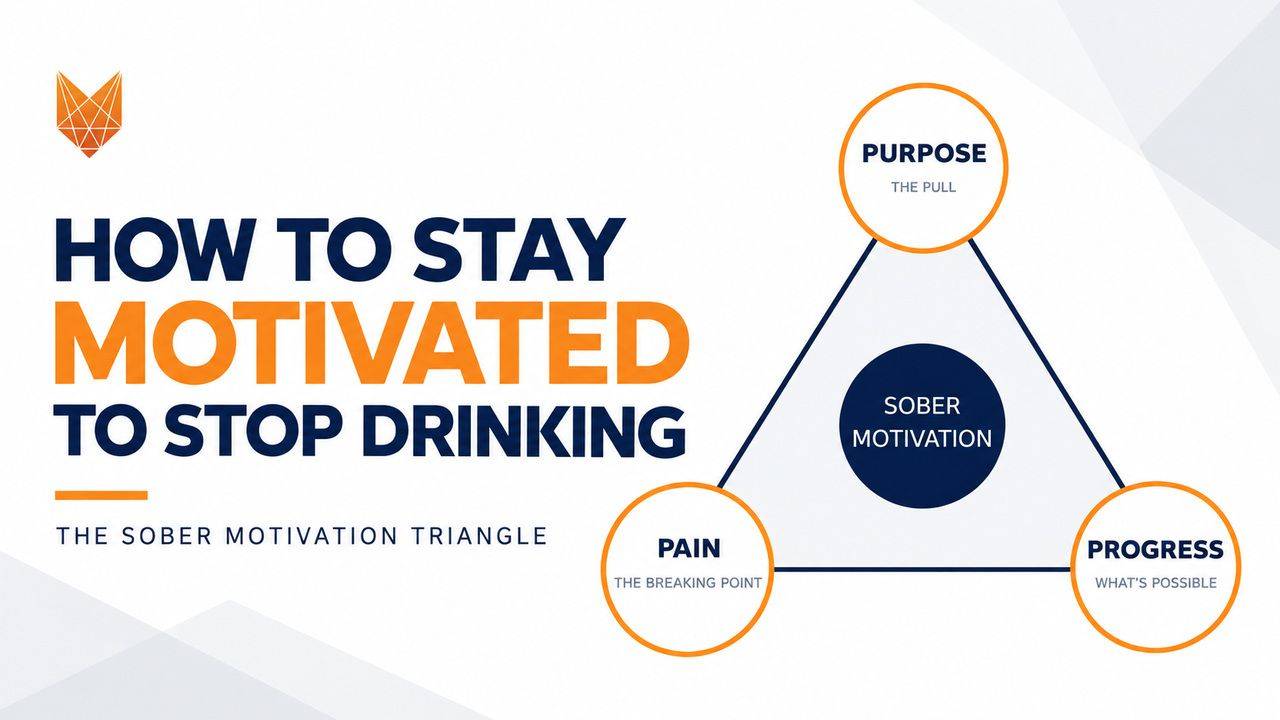
At first, pain often creates the motivation to stop drinking. As your life improves, progress gives you a reason to continue. Eventually, you need a compelling future pulling you forwards.
I call this the Sober Motivation Triangle:
-
The Breaking Point
-
What’s Possible
-
The Pull
Understanding these three stages can help you reconnect with your reasons for not drinking and build a life in which alcohol becomes increasingly irrelevant.
Why does motivation to stop drinking change over time?
Last week I met up with a cool dude named Davey.
He flew all the way from Sydney to London just to see me...
I jest.
He was travelling around Europe and reached out to ask if I fancied meeting up.
So we went for a coffee and a walk. We talked about all things sobriety, learnt more about each other’s families and spoke about what might be next in life.
I left our conversation inspired and thinking about an important question:
What am I going to do with the life I’ve got back?
There comes a point when sobriety can’t only be about the thing you stopped doing.
When you first question your relationship with alcohol, your motivation may come from feeling exhausted, frustrated or frightened about where your drinking is heading.
That discomfort can be powerful. It can finally get you to say, “Enough. Something needs to change.”
But then your life starts getting better.
You wake up without anxiety. You’re more patient with your children. You have more energy. You start keeping the promises you make to yourself.
The pain that initially motivated you begins to fade.
That is a good thing, but it also means your motivation needs to evolve.
The reason that helps you stop drinking might not be the reason that keeps you going.
What is the Sober Motivation Triangle?
The Sober Motivation Triangle is a coaching framework I created to help people understand and strengthen their motivation to stop drinking.
It has three connected parts:
-
Pain creates the Breaking Point: You recognise what alcohol is costing you and decide that something must change.
-
Progress reveals What’s Possible: You notice the improvements in your life and begin believing that the change is worth continuing.
-
Purpose creates The Pull: You develop a compelling picture of the person you want to become and the life you want to create.
You may draw motivation from all three parts at the same time. However, one will often feel more important depending on where you are in your journey.
When someone says, “I’ve lost my motivation,” I don’t think that necessarily means motivation has disappeared.
It may mean they have lost connection with one part of their triangle.
Stage 1: The Breaking Point
What makes someone decide to stop drinking?
For many people, the initial motivation to stop drinking comes from pain.
You may be fed up with waking up anxious and trying to remember what you said the night before.
You might be tired of promising yourself that you’ll only have one or two drinks, then doing the same thing again.
Perhaps your family gets the impatient, distracted or tired version of you.
Maybe you’re doing well on paper, but you have a growing suspicion that alcohol is stopping you from discovering what you’re genuinely capable of.
Nothing catastrophic needs to happen before you decide to change.
Sometimes your breaking point comes from having the foresight to recognise where the pattern is heading.
That was part of my experience.
When I first started rethinking alcohol, I had a suspicion that I could do more without it. What surprised me was how difficult I found it to take a break.
That told me something.
Alcohol had more of a hold over me than I wanted to admit.
Your breaking point might arrive after one dramatic event, but it can also develop quietly through hundreds of mornings when you know you don’t want to keep feeling this way.
Questions to help you reconnect with your breaking point
Ask yourself:
-
What was alcohol costing me?
-
What had I become unwilling to tolerate?
-
How was drinking affecting the people closest to me?
-
Where was this pattern heading if nothing changed?
-
What do I never want to return to?
This isn’t about making yourself feel bad or living in fear of alcohol.
It is about remembering the truth.
Your mind will often remember the relaxing first drink while conveniently editing out the anxiety, arguments, poor sleep and broken promises that followed.
Remembering the full cost of drinking can help you understand why you made the decision to change.
Pain might give you a reason to stop.
Stage 2: What’s Possible
How does progress help you stay motivated not to drink?
Eventually, your motivation begins to shift.
You are no longer only focused on what you are escaping. You start noticing what you are creating.
Perhaps you finish work and still have enough energy and patience left for your family.
Maybe you wake up after a social event feeling proud because you were fully present and remember every conversation.
You handle a stressful week without disappearing into alcohol.
Your partner begins trusting you again.
You begin trusting yourself again.
These moments matter because they provide evidence.
You aren’t merely hoping that life without alcohol might be better. You are experiencing the difference for yourself.
However, progress can be easy to overlook.
Once better sleep, calmer mornings and increased energy become normal, you may stop recognising them as benefits of not drinking.
You forget how much effort basic things used to require. The life you once wanted becomes the life you now take for granted.
This is why noticing progress is an essential part of sustaining sober motivation.
Questions to help you recognise your progress
Ask yourself:
-
What has improved since I changed my relationship with alcohol?
-
What can I do now that I previously struggled to do?
-
How are the people closest to me experiencing me differently?
-
Which promises am I now keeping to myself?
-
What am I proud of?
-
What have I created that I am no longer willing to lose?
Don’t limit your answers to physical benefits such as improved sleep or increased energy.
Look at who you are becoming.
You might be calmer under pressure, more emotionally available, more confident socially or more willing to have difficult conversations.
Each of these changes gives you evidence that you can trust yourself.
Progress gives you a reason to continue.
Stage 3: The Pull
Why is purpose important after you stop drinking?
There comes a point when not drinking can’t be the biggest thing happening in your life.
I don’t want you to spend every morning thinking, “I must not drink today.”
If taking sobriety one day at a time works for you, brilliant. But I don’t believe alcohol has to remain at the centre of your life forever, even as something you are constantly trying to avoid.
At some point, the conversation needs to shift from:
How do I keep myself from drinking?
To:
What am I going to do with the life I’ve got back?
You need something pulling you forwards.
That might mean building a relationship in which your partner feels close to you again.
It might mean becoming the dad your children can talk to, trust and rely on.
You could create a business that gives you the freedom to travel, spend more time with your family and create experiences you’ll still laugh about years from now.
Perhaps you want to become stronger and healthier so you can enjoy an active and adventurous second half of your life.
Maybe you want to contribute through your work, support other people or finally discover what you are capable of when you stop operating at 70 per cent.
Your future doesn’t need to look impressive to anyone else.
But it has to feel important to you.
There is a big difference between knowing that something matters logically and feeling emotionally connected to it.
“I want to be healthier” is a perfectly reasonable goal.
“I want to be strong enough to play football with my children now, travel with them when they’re older and become an active grandfather one day” carries more emotional weight.
“I want to be more present” sounds positive.
“I want my children to remember that I listened to them, knew what was happening in their lives and was someone they could always rely on” means something deeper.
The more specific your future becomes, the more powerfully it can pull you towards it.
Questions to help you create a compelling future
Ask yourself:
-
What do I want my life to become?
-
What kind of man do I want to be?
-
How do I want the people closest to me to experience me?
-
What do I want to create, experience or contribute?
-
Who benefits when I become this version of myself?
-
What kind of life do I want so deeply that alcohol is no longer worth trading it for?
You don’t need to spend the rest of your life running away from the person you were.
At some point, you need to become deeply connected to the person you want to be.
Purpose gives you a future you refuse to trade for alcohol.
Why does sober motivation sometimes feel low?
Motivation isn’t something you are either born with or not.
It is something you create by directing your attention towards the reasons and outcomes that matter to you.
When motivation feels low, it doesn’t necessarily mean you no longer want to stop drinking. It may mean that you have lost connection with one part of the Sober Motivation Triangle.
You may have lost connection with your pain
You start romanticising alcohol and remembering selected moments rather than the complete experience.
You remember the laughter but forget the anxiety.
You remember the first drink but forget how difficult it became to stop.
You remember the temporary relief but forget what drinking took from you afterwards.
You may have stopped noticing your progress
The benefits of not drinking have become normal, so you no longer recognise how much has changed.
You focus on how far you still have to go instead of acknowledging the person you have already become.
You may have lost sight of your purpose
Sobriety begins to feel like an endless act of restraint.
Your attention remains fixed on what you can’t have rather than what you are now free to create.
The answer is not always to try harder.
Sometimes you need to identify which part of your motivation needs your attention.
What should you do when you lose motivation to stay sober?
Try this quick Sober Motivation Triangle check-in.
Score your current connection to each area from 1 to 10:
-
The Breaking Point: How connected am I to the reasons I wanted to change?
-
What’s Possible: How clearly am I noticing the benefits and progress I have made?
-
The Pull: How emotionally connected am I to the future I am creating?
Then reflect on why you chose each score.
Your lowest number may show you where some attention is needed.
If you feel disconnected from your breaking point, write honestly about what alcohol was costing you.
If you aren’t noticing your progress, list what has improved and ask someone close to you what they have observed.
If your future feels vague, make it more specific. Picture what an ordinary day in that life would look and feel like. Think about where you would live, how you would spend your time and how the people you love would experience you.
Then take one action that strengthens that part of the triangle.
You don’t need to solve your whole life today.
You only need to reconnect with the reason your next decision matters.
Do you need one powerful reason to stop drinking forever?
No. Your reasons for not drinking are allowed to evolve as you do.
The motivation that gets you through your first alcohol-free weekend may not be enough five years later.
That does not mean your original reason was wrong.
It means it did its job.
Pain can help you recognise that something needs to change. Progress shows you that another life is possible. Purpose helps you build a future in which alcohol no longer belongs.
You don’t need one perfect “why” that lasts forever.
You need to stay connected with what matters now.
Frequently asked questions about sober motivation
Why does my motivation to stop drinking keep fading?
Motivation often fades because the negative consequences of drinking become less immediate as your life improves. This doesn’t mean you want the change any less. Your motivation may need to shift from avoiding past pain to recognising your progress and creating a compelling future.
How can I stay motivated not to drink?
Reconnect regularly with three things: what drinking was costing you, what has improved since you stopped and what you want to create with the time, energy and attention you have regained. These form the three parts of the Sober Motivation Triangle.
Is willpower enough to stop drinking?
Willpower may help you through individual moments, but it is unreliable as a long-term strategy. Lasting change is supported by clear reasons, altered routines, supportive relationships, practical ways of managing stress and a future that matters to you.
What should I do if I forget how bad my drinking was?
Write down the full experience rather than relying on memory. Include what happened before, during and after drinking. Consider the effects on your sleep, anxiety, relationships, energy, work and self-respect. The aim is not to punish yourself. It is to remember accurately.
Why does sobriety sometimes feel boring?
Sobriety can feel boring when alcohol has been removed but nothing meaningful has replaced the role it occupied. This can be an invitation to explore new relationships, interests, challenges, experiences and goals rather than evidence that life without alcohol is inherently dull.
How do I find purpose after stopping drinking?
Start with what matters personally rather than what looks impressive. Consider the relationships you want to deepen, the experiences you want to have, the work you want to create and the kind of person you want to become. Purpose becomes motivating when it is specific enough for you to feel emotionally connected to it.
Build a life you don’t want to trade for alcohol
Your motivation is allowed to change.
In fact, it needs to.
The aim isn’t to spend the rest of your life fighting the urge to drink or keeping alcohol at the centre of your attention.
It is to create a life in which drinking makes less and less sense.
Remember:
Pain might give you a reason to stop. Progress gives you a reason to continue. Purpose gives you a future you refuse to trade for alcohol.
If you want to explore this idea further, listen to Episode 257 of The Alcohol ReThink Podcast. I’ll take you through The Breaking Point, What’s Possible and The Pull, and help you understand what your sober motivation might need next.
